
Internet in the Canary and Balearic Islands: What to Expect
The islands are part of Spain for mobile coverage, but not always for tax, shipping or roaming small print. Here is what genuinely differs from the mainland.
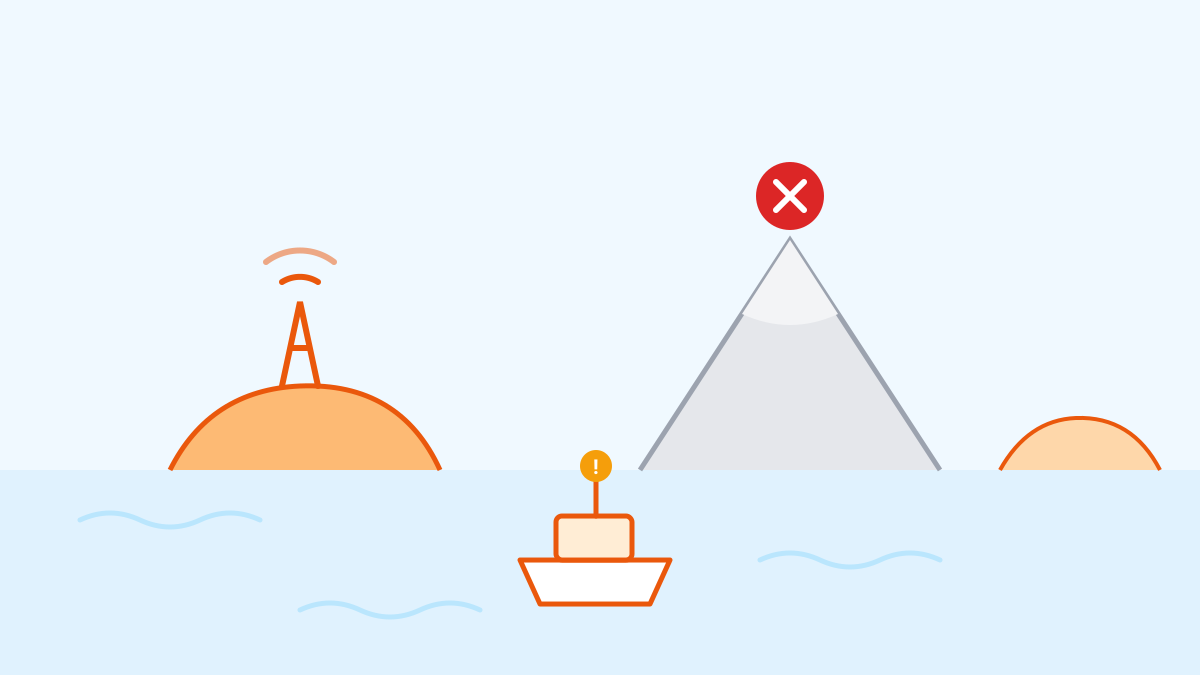
Both archipelagos are fully part of Spain for mobile networks. A Spanish SIM or eSIM works in Tenerife and Mallorca exactly as it does in Madrid, with no surcharge and no separate plan.
Where the islands genuinely differ is in the physical logistics and a few pieces of small print — and in where coverage stops.
Coverage is good, with specific gaps
Tourism density means the islands are well served. Resort areas, towns and main roads have solid 4G and increasingly widespread 5G. In the busier parts of Mallorca, Tenerife and Gran Canaria you would struggle to notice any difference from a mainland city.
The gaps are geographic and predictable:
- Teide National Park (Tenerife). The high volcanic plateau has patchy coverage, and it disappears entirely in parts of the crater and on the ascent trails.
- The Anaga massif (Tenerife) — steep, forested, deeply folded terrain where signal comes and goes valley by valley.
- La Palma and La Gomera ridges. Both islands are mountainous and thinly populated away from the coast road. Coverage follows the settlements.
- Serra de Tramuntana (Mallorca). The northern mountain range has dead spots on the hiking routes and along some of the switchback roads.
- Inland Fuerteventura and Lanzarote. Sparse population, long empty stretches, though the main roads are fine.
If you are hiking any of these, download offline maps before setting out. This is standard advice everywhere but matters more on islands where a wrong turn on a volcanic trail is genuinely serious.
The roaming and VAT distinction
A recurring confusion: the Canary Islands are inside the EU for roaming, so EU roaming rules apply as normal. But they are outside the EU VAT area and outside the EU customs union for goods.
That second part has no effect on your phone. It has a real effect on anything shipped to you — parcels to the Canaries clear customs separately and take longer than mainland deliveries.
The Balearics are inside both, so nothing special applies there at all.
What this means practically
The customs point matters if you want a physical device.
Ordering a pocket WiFi hotspot or data SIM to the Canaries is possible but needs lead time. Island delivery is slower than mainland, and the customs step adds unpredictability. If your holiday is short, a delayed parcel eats the trip.
An eSIM for Spain sidesteps this entirely. It arrives by email as a QR code, so there is no parcel, no customs, and no delivery window to plan around. For the islands specifically, this is the meaningful practical advantage — less about the technology and more about logistics.
For the Balearics, mainland delivery timescales broadly apply, so a physical device is straightforward.
Ferries and inter-island travel
Inter-island ferries — common in both archipelagos — lose signal once properly offshore. Crossings range from twenty minutes to several hours.
Nothing to arrange, but worth knowing if you plan to work on a longer crossing, or if you were relying on arriving with a booking confirmation you have not yet downloaded. Screenshot tickets before boarding.
Onboard WiFi exists on some routes and is generally slow and heavily shared.
Short version
- Spanish SIM and eSIM plans work on both archipelagos at no extra cost
- Coverage is strong in towns and resorts, patchy in volcanic interiors and mountain ranges
- Canaries: inside the EU for roaming, outside for VAT and customs — which affects parcels, not phones
- If travelling to the Canaries and you want a physical device, order early; otherwise an eSIM avoids shipping altogether
- Download offline maps before any serious hiking, particularly on Teide, Anaga and the Tramuntana