
How Much Data Do You Actually Need in Spain? A Realistic Guide
Maps, WhatsApp, a few reels and the odd Netflix episode — here is what a week in Spain really costs in gigabytes, and when unlimited is the cheaper option.
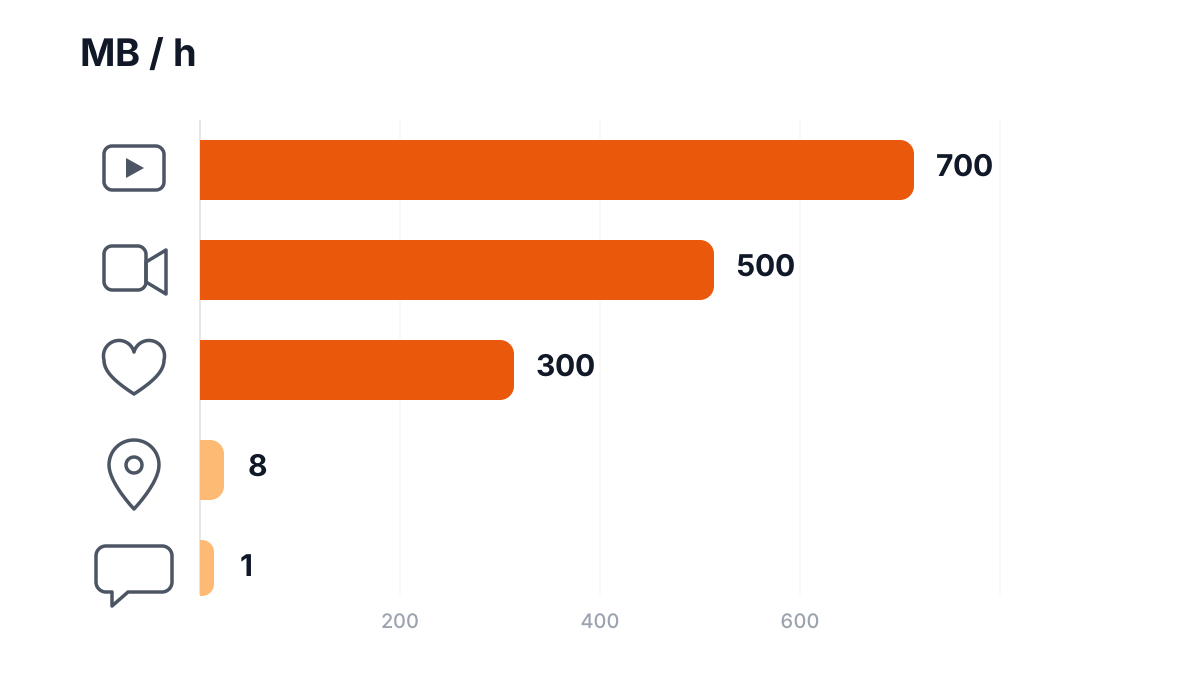
Most people planning a trip to Spain wildly overestimate how much data maps use, and wildly underestimate how much their phone uses in the background. That mismatch is why so many travellers buy a 3 GB plan and hit the wall on day four.
Here is what a week actually looks like.
What each activity really costs
These are realistic averages for a modern smartphone at typical mobile resolutions.
| Activity | Data used | A week of it |
|---|---|---|
| WhatsApp messaging (text) | ~1 MB per 100 messages | Under 50 MB |
| Google Maps navigation | 5–10 MB per hour | 100–300 MB |
| Instagram / TikTok scrolling | ~150 MB per 30 min | 2–5 GB |
| Netflix or YouTube (standard) | ~700 MB per hour | 3–7 GB |
| Video calls | ~500 MB per hour | 1–3 GB |
| Automatic photo backup | ~2 MB per photo | 1–4 GB |
| Background app sync | 20–50 MB per day | 150–350 MB |
The pattern is consistent: navigation and messaging are trivial, video and photo backup dominate. If you never open a video app and turn off cloud backup, a fortnight on 5 GB is comfortable. If you scroll reels on the beach for an hour a day, you will pass 5 GB before the week is out.
A rough planning rule
For a single traveller, per week:
- Light use — maps, messaging, email, no video: 2–4 GB
- Typical use — the above plus social media and some photo backup: 6–10 GB
- Heavy use — regular streaming, video calls, working remotely: 15–25 GB+
Then apply two multipliers that catch people out.
Travelling as a group. Data is per connection, not per person. Two phones on separate plans need two plans. One pocket WiFi hotspot shared across four devices needs one — which is usually why groups end up paying less per person that way.
Using a laptop. The moment you tether a laptop, the arithmetic changes. Operating-system updates alone can be several gigabytes, and they love to trigger on an unfamiliar network. If you plan to work from Spain, assume your laptop will quietly consume more than your phone.
When unlimited is simply cheaper
Capped plans look cheaper per gigabyte right up until you need a second one. The real cost of a capped plan is not the price — it is the mid-trip decision about whether to ration data or buy more.
Unlimited makes sense when you are:
- staying longer than about ten days
- sharing a connection with other people or devices
- working remotely, where a stalled upload costs you real time
- travelling with anyone who will not think about data usage at all
If your trip is short and your usage genuinely light, a small data SIM or eSIM plan is perfectly sensible. The mistake is buying a small plan for a long trip and hoping.
Two settings worth changing before you fly
Whatever plan you choose, these two changes save more data than any amount of rationing:
- Turn off automatic photo backup on mobile data. On iPhone: Settings → Photos → Mobile Data → off. On Android: Google Photos → Profile → Backup → Back up over Wi-Fi only. This alone often halves consumption.
- Cap streaming quality. Netflix, YouTube and Spotify all have a mobile-data quality setting. Dropping video to "standard" roughly halves its cost, and on a phone screen the difference is hard to notice.
Do those two things and the "typical use" figure above drops toward the light-use end — which may well change which plan you need.